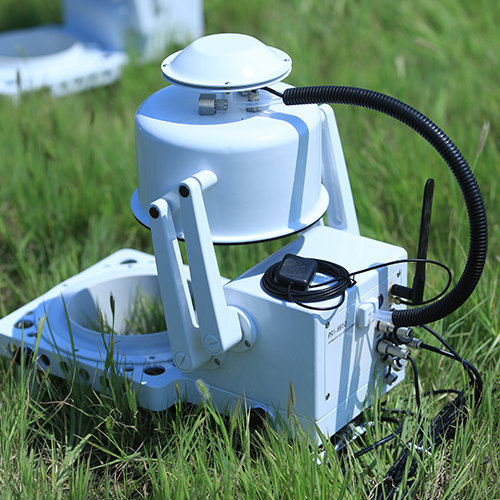
Designed for Measurement Integrity
Beyond Automation.
Beyond Multiplexing.
From Soil Respiration to Ecosystem Carbon Exchange Partitioning
Measuring Carbon Is Easy.
Measuring It Correctly Is Difficult.
Over the past two decades, automated chambers have enabled continuous measurements, while distributed systems have improved spatial coverage.
Yet key sources of uncertainty remain.
Chamber-Induced Disturbance
Measurement systems should minimize their influence on natural gas exchange.
Spatial Variability
Carbon fluxes often vary substantially over short distances.
Representative Sampling
A single sampling point may not adequately represent the entire chamber environment.
Environmental Interpretation
Understanding why fluxes change often requires more than flux measurements alone.
The challenge is no longer measuring CO₂.
The challenge is measuring it correctly and understanding what drives it.
Designed Around Measurement Integrity
The PRI-8650 was developed to address key sources of uncertainty associated with chamber-based flux measurements.
Rather than focusing solely on automation, the system is designed to improve measurement quality at both the chamber and ecosystem scales.
Dynamic Pressure Equilibrium™
Designed to minimize pressure differences between the chamber interior and the surrounding atmosphere throughout the measurement cycle.
Helps preserve natural soil–atmosphere gas exchange conditions and reduce potential measurement artifacts.
Distributed Spatial Sampling
Multi-point gas collection architecture designed to improve chamber-scale concentration representativeness.
Helps reduce the influence of localized concentration gradients within the chamber.
Cylindrical Chamber Architecture
Designed to provide a consistent internal environment while minimizing corner effects and airflow discontinuities.
Supports stable and repeatable long-term measurements.
Designed to reduce uncertainty at its source.
One Platform.
Three Research Configurations.
Different scientific questions require different observation approaches.
The PRI-8650 platform supports three chamber configurations optimized for specific research objectives.
PRI-8650 Soil Respiration System
Opaque Chamber
Primary Output: Rs, Soil Respiration
PRI-8650C Net Ecosystem Exchange System
Transparent Chamber
Primary Output: NEE,Net Ecosystem Exchange
PRI-8650D Carbon Partitioning System
Dual Chamber
Primary Outputs: NEE, Reco, GPP
One Platform.
Multiple Perspectives on Carbon Cycling.
Understanding What Drives Carbon Fluxes
Carbon exchange does not occur in isolation.
Its variability is often controlled by interactions among radiation, temperature, moisture, and atmospheric conditions.
To support ecosystem process interpretation, the PRI-8650 data acquisition system can integrate environmental and meteorological measurements alongside carbon flux observations.
Available measurements include:
- PAR
- Air Temperature
- Relative Humidity
- Soil Temperature
- Soil Moisture
- Rainfall
- Wind Speed and Direction
- Atmospheric Pressure
Derived parameters include:
- VPD
- Dew Point
Environmental and meteorological integration packages are available as optional configurations.
Measuring carbon flux is important.
Understanding why it changes is even more important.
From Individual Plots to Ecosystem Understanding
Carbon cycling processes rarely occur uniformly across landscapes.
Single-point observations often fail to capture the variability that exists across ecosystems.
The PRI-8650 utilizes distributed independent measurement nodes that can operate individually or as coordinated observation networks.
Researchers can scale observations from individual plots to ecosystem-level investigations while maintaining standardized measurements throughout the network.
Applications
Forest Ecosystems
Long-term carbon cycling studies across heterogeneous landscapes.
Grasslands
Spatial variability and ecosystem productivity research.
Wetlands
Carbon exchange dynamics in complex environments.
Agricultural Systems
Management impacts on soil carbon cycling and ecosystem productivity.
Permafrost Regions
Climate feedback and carbon release studies.
Designed for High-Density Carbon Flux Observations.
Technical Specifications
Technical Specifications
Measurement Configurations
|
Model |
Chamber Configuration |
Primary Outputs |
|
PRI-8650 |
Opaque Chamber |
Rs |
|
PRI-8650C |
Transparent Chamber |
NEE |
|
PRI-8650D |
Dual Chamber |
NEE, Reco, GPP |
Gas Analysis
|
Parameter |
Specification |
|
Measurement Principle |
Non-Dispersive Infrared (NDIR) |
|
CO₂ Measurement Range |
0–2,000 ppm |
|
CO₂ Accuracy |
±2% of Reading |
|
H₂O Measurement Range |
0–6% |
|
H₂O Accuracy |
±2% |
Environmental Measurements
|
Parameter |
Specification |
|
Air Temperature |
-40 to +85 °C |
|
Soil Temperature |
-40 to +85 °C |
|
Soil Moisture |
0–100% |
Chamber Technologies
- Dynamic Pressure Equilibrium™
- Distributed Spatial Sampling
- Cylindrical Chamber Architecture
- Co-Located Dual-Mode SoilFlux System
Observation Network
- Distributed Independent Nodes
- Wireless Communication
- Network-Level Time Synchronization
- Cloud-Based Data Storage
- Remote Diagnostics
Power & Physical Specifications
|
Parameter |
Specification |
|
Power Consumption |
12 W |
|
Power Input |
12 VDC |
|
Solar-Powered Operation |
Standard |
|
Dimensions |
45.4(L) × 27.3(W) × 23.5(H)cm |
|
Weight |
9.5 kg |
Optional Environmental Monitoring
PAR | Relative Humidity | Rainfall | Wind Speed | Wind Direction | Atmospheric Pressure
Reimagining Soil Respiration Measurements
The PRI-8650 combines advanced chamber engineering, distributed observation architecture, and environmental monitoring into a unified platform for modern ecosystem carbon research.
Designed to help researchers obtain more representative carbon flux measurements while improving ecological interpretation across space and time.
PRI-8650
Distributed Soil Carbon Flux System
Designed for Measurement Integrity.
Beyond Automation.
Beyond Multiplexing.
Mastering Precision
Sensing Nature